

• Blog
  • About
  • Mailing List
Menu

The Mindful Catholic

Street Address
City, State, Zip
Phone Number
God in everything We do

Your Custom Text Here

The Mindful Catholic

  • Blog
  • About
  • Mailing List

Stop the Performance: How to Offer Your Emptiness to God

June 7, 2026 Kurt Henson

I spent twenty minutes yesterday just trying to look like I had my life together. I was standing in line at Sam's Club, completely drained from a brutal week, my mind racing through a massive to-do list, yet I found myself putting on a polite, "holy" smile for the people around me. Why do we do that? Why are we so terrified of letting people—and let’s be honest, letting God—see us when we are running on absolute empty? We are addicted to the performance of being okay.

This is exactly why the words of Mark 12:38-44 hit so close to home.

Jesus is sitting near the temple treasury, watching the crowd. First, He calls out the scribes. These guys were professionals at looking important. They loved wearing long robes, taking the best seats, receiving public respect, and making a massive show of long prayers. They were masters of religious performance, but their hearts were completely detached from God. Then, the wealthy walk up, dumping huge amounts of money into the collection bins. It was loud, it was impressive, and it was entirely an exhibition to be seen by others.


And then walks up this nameless widow. She doesn't have a performance to give. She has no status, no robes, and no wealth. She drops in two tiny copper coins—basically worth a fraction of a cent. To anyone watching, it was completely insignificant. It wouldn't even pay for the temple's upkeep for an hour. But Jesus stops everything. He calls His disciples over because He wants them to look past the show. He tells them she put in more than everyone else combined. The rich gave out of their surplus, but she gave out of her poverty. She gave everything she had to live on.


When my life feels chaotic, I realize I act exactly like those rich people at the treasury. I think I can only approach God when I have a "surplus" to offer Him. I wait until I have a pocketful of peace, a perfectly quiet morning, or a beautiful, coherent prayer to bring to the altar. I want to perform my faith. But what happens when you’re completely bankrupt? What happens when you’re sitting on the edge of your bed, staring at the floor, with nothing left but a heavy heart and a mind that won't stop screaming?

That’s the moment we have to stop trying to manufacture a feeling and just radically refocus on God.

A few days ago, when I was at my breaking point, I didn't have a grand prayer. I couldn't even form words. I just stopped. I closed my eyes right there at my desk, ignored the blinking notifications, and turned my entire attention to the fact that God was in the room. I offered Him my emptiness. I didn't try to fix my anxiety first; I just acknowledged Him. I said, "Lord, I have absolutely nothing today. I am tired, I am overwhelmed, and I have no holy thoughts. But I am Yours."

That raw, unfiltered second of attention—that is our two copper coins.

Refocusing on God is not a self-help exercise to clear your mind or lower your stress. It is a radical act of spiritual surrender. It means stopping the hustle, stopping the religious show, and glorifying Him simply because He is God, right in the middle of our bankruptcy. We give Him glory first, not because our day is perfect, but because He is perfect when our day is falling apart.

Jesus didn't praise the widow because she fixed her poverty; He praised her because she trusted God with it. He doesn't want your curated, polished surplus. He wants you. He wants the real, exhausted, broken version of you that stops running long enough to recognize His holy presence.

So look away from the treasury of your worries for just a second. Stop trying to buy your way into peace with a better performance. Give Him the glory right now for the breath in your lungs. Turn your gaze away from your problems and put your focus entirely on Him.


The crowd will keep shouting, the performance will always demand more, and the tank might run dry—but the Way is Jesus, and He isn't going anywhere. Close your eyes for three seconds. Breathe. He is here. Give Him your emptiness, and let Him be your everything.
In Bible Study, Christianity, Mindfulness, Personal Growth, Spirituality Tags Spiritual Surrender, Widow's Mite, Spiritual Burnout, Faith, Mindfulness, Christian Living, Religious Performance, Authentic Faith, Gospel Reflection, Trusting God
Comment

Finding Peace in the Storm: Letting Go of the Need to Control

April 19, 2026 Kurt Henson

I woke up at 4:30 AM today with that familiar weight sitting right on my chest. Before I even had a chance to say a morning offering, my mind was already racing through the "to-do" list, calculating how I was going to fix the things that felt broken and how I was going to finally get ahead of the curve. If you’ve ever felt like you’re constantly red-lining your engine just to stay in the same place, you know exactly where I was. It’s that exhausting internal rhythm of trying to be "enough" through sheer force of will. We row harder to fix our relationships, we row harder to climb the ladder at work, and we row harder to be the "perfect" version of ourselves. But eventually, the wind gets too strong, the water gets too rough, and we find ourselves three miles into a dark sea, wondering why we feel so alone.

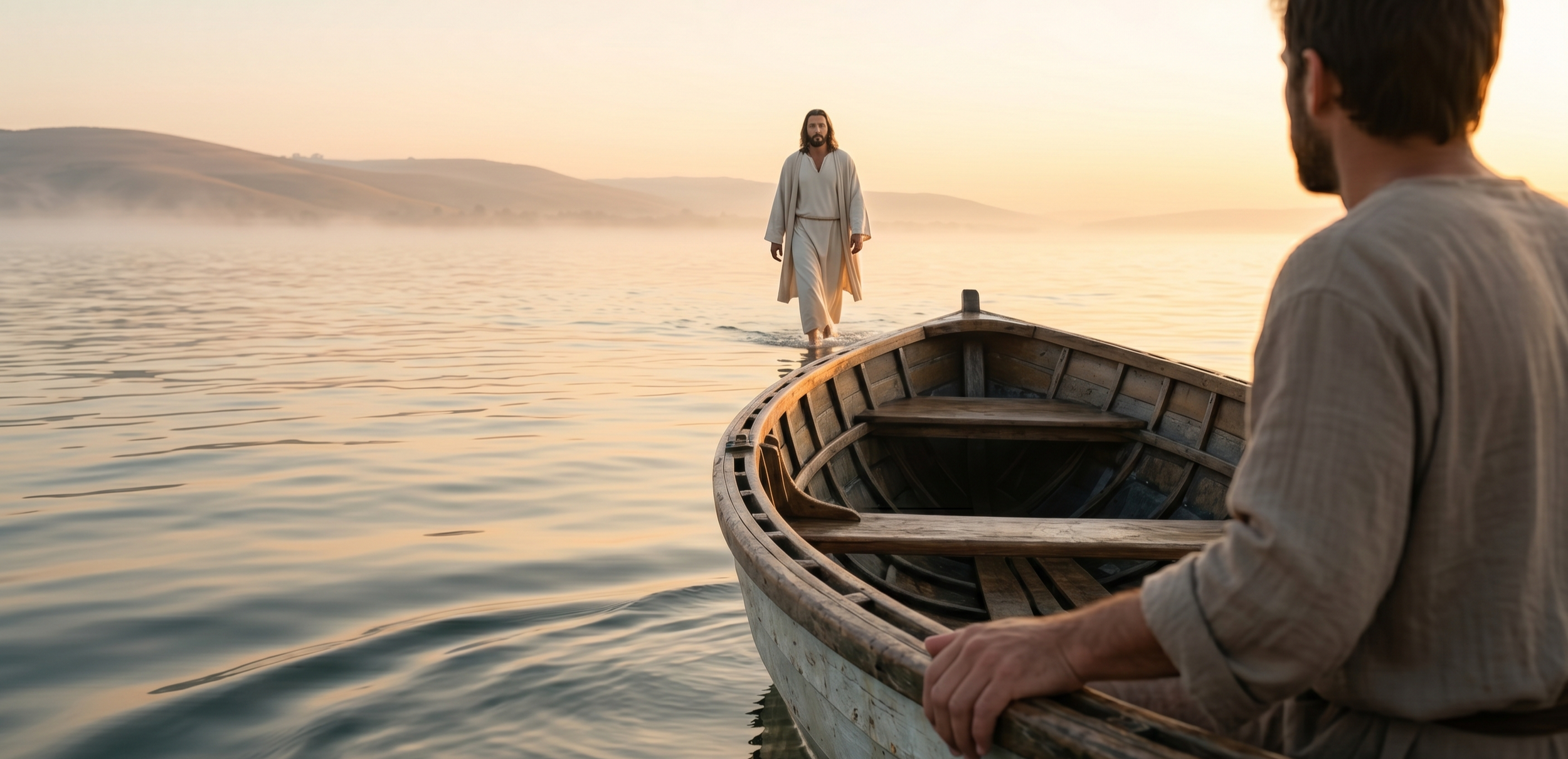
Lately, I’ve been sitting with the story of the disciples on the Sea of Galilee in John 6. It’s a passage that has completely reframed my daily struggle. We often think that if we are doing what God wants, the path should be smooth. But look at these men: they were in that boat because they were following instructions. They were in a life-threatening storm precisely because they were being obedient. I’ve had to admit to myself that my "troubled waters" aren't always a sign that I’ve failed or taken a wrong turn. Sometimes, the storm is the very place where God intends to reveal who He is. The disciples weren't failing because they were struggling; they were just experiencing the limits of being human.

When they saw Jesus walking on the waves, the text says they were terrified. They didn't see a Savior at first; they saw a ghost or just another problem to deal with. Jesus speaks five words that change everything: "It is I; do not be afraid." In the original language, he says Egō eimi—"I AM." He isn't just identifying himself; he is claiming the very name of God. He’s telling them that the Sovereignty that created the waves is now standing on top of them. This is where mindful living moves from a "self-help" technique to a spiritual reality. It’s the practice of pausing mid-row—hands cramped and heart racing—and acknowledging the Presence that is already there. God isn't waiting for you to reach the shore so He can congratulate you on your effort; He is standing on the very waves that are scaring you right now.

I recently told a friend that it’s one thing to admit I need God, but it’s a whole different battle to actually stand by that when the pressure hits. Admitting we need help is an intellectual moment, but "standing" is a physical endurance test. Standing by the Word means that when the internal noise of fear starts screaming—when the project fails, or the house is a mess, or your own self-reliance tells you that you’re drifting into failure—you choose to stay in the "boat" of faith. You refuse to let the panic dictate your next move.

To live this out, I’ve had to change my daily mechanics. When I feel that urge to "row harder" out of pure panic, I stop. I take a deep breath and internally repeat those words: "It is I... do not be afraid." This isn't just about calming my nerves; it’s about tethering my soul to the reality of His Sovereignty. I’ve started looking at those thoughts that tell me I’m a "drifting failure" as distractions meant to make me abandon my peace. I’m learning to replace the "toiling in rowing" with a simple, willing invitation. Every morning, I try to physically open my hands and say, "Lord, I am willing to take You into this boat today. I’m dropping the oars."

The most beautiful part of the story is how it ends. The moment they were willing to take Him into the boat, they were immediately at the land where they were going. When we stop relying on our own frantic momentum and start relying on His Presence, the trajectory of our life shifts. We might still be in the middle of a difficult season, but our destination becomes secure because the "I AM" is with us. If you’re tired of the "same but different day" battle, I want to encourage you to stop trying to be the engine of your own salvation. You weren't meant to carry the weight of the storm. Glorify Him today not by how hard you can work, but by how radically you can depend on Him. Take Him into your boat, and let the rowing end.

What is one area of your life today where you can physically "drop the oars" and invite His presence in?


In Bible Study, Christianity, Mindfulness, Personal Growth, Spirituality Tags Catholic Living, Christian Faith, Bible Study, Spiritual Growth, Gospel of John, Jesus Christ, Word of God, Mindful Catholic, Christian Mindfulness, Surrender to God, Finding Peace, Spiritual Burnout, Inner Peace, Mental Health and Faith, John 6:16-21, Jesus Walking on Water, Stop Rowing Harder, Trusting God in Storms, Letting Go of Control, Self-Reliance, Daily Devotional, How to trust God when life is hard, Meaning of Jesus walking on water, Stopping the cycle of self-reliance, Catholic mindfulness practices
Comment

THe Mindful catholic