
• Blog
  • About
  • Mailing List
Menu

The Mindful Catholic

Street Address
City, State, Zip
Phone Number
God in everything We do

Your Custom Text Here

The Mindful Catholic

  • Blog
  • About
  • Mailing List

Finding Peace in the Storm: Letting Go of the Need to Control

April 19, 2026 Kurt Henson

I woke up at 4:30 AM today with that familiar weight sitting right on my chest. Before I even had a chance to say a morning offering, my mind was already racing through the "to-do" list, calculating how I was going to fix the things that felt broken and how I was going to finally get ahead of the curve. If you’ve ever felt like you’re constantly red-lining your engine just to stay in the same place, you know exactly where I was. It’s that exhausting internal rhythm of trying to be "enough" through sheer force of will. We row harder to fix our relationships, we row harder to climb the ladder at work, and we row harder to be the "perfect" version of ourselves. But eventually, the wind gets too strong, the water gets too rough, and we find ourselves three miles into a dark sea, wondering why we feel so alone.

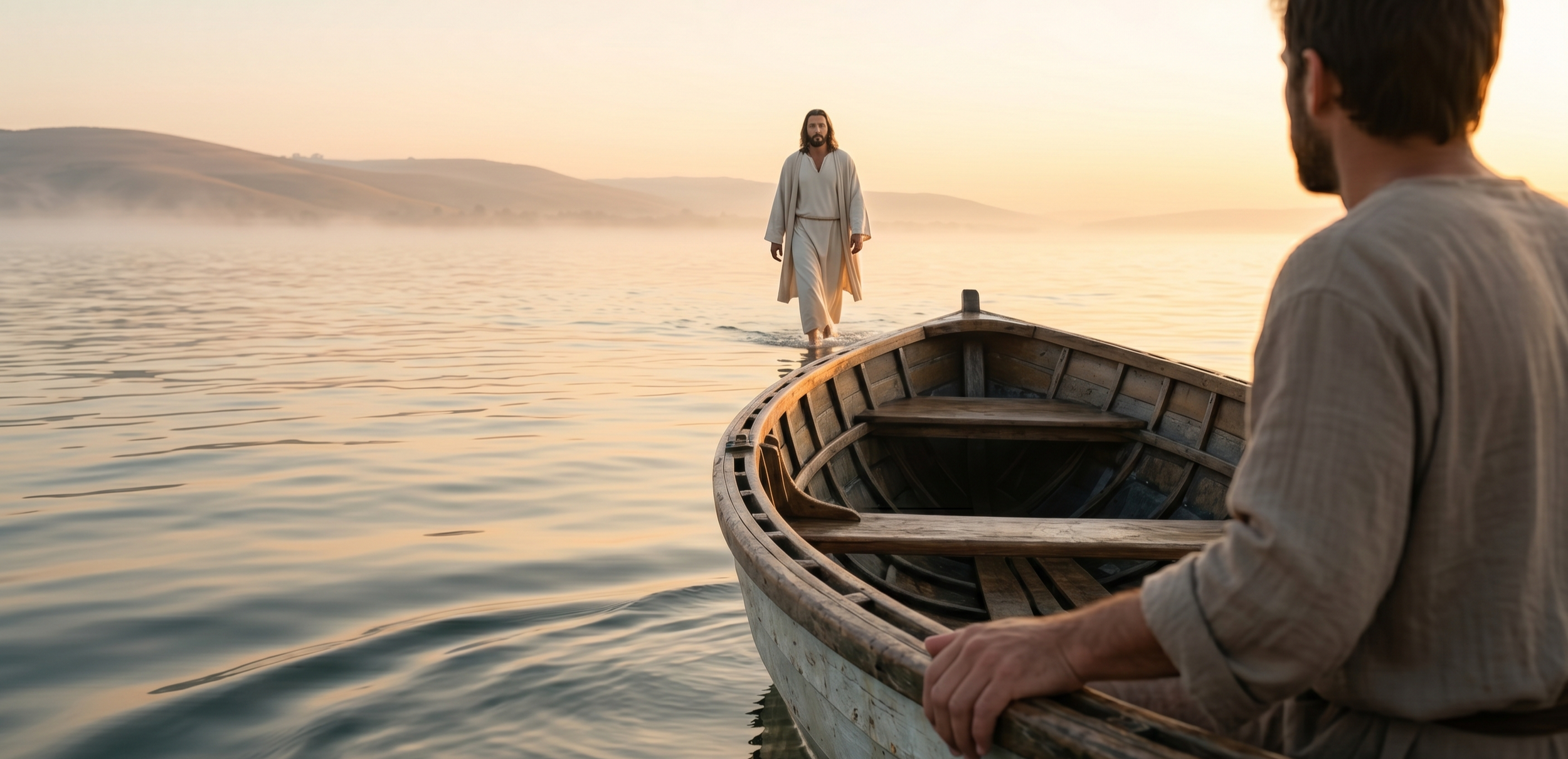
Lately, I’ve been sitting with the story of the disciples on the Sea of Galilee in John 6. It’s a passage that has completely reframed my daily struggle. We often think that if we are doing what God wants, the path should be smooth. But look at these men: they were in that boat because they were following instructions. They were in a life-threatening storm precisely because they were being obedient. I’ve had to admit to myself that my "troubled waters" aren't always a sign that I’ve failed or taken a wrong turn. Sometimes, the storm is the very place where God intends to reveal who He is. The disciples weren't failing because they were struggling; they were just experiencing the limits of being human.

When they saw Jesus walking on the waves, the text says they were terrified. They didn't see a Savior at first; they saw a ghost or just another problem to deal with. Jesus speaks five words that change everything: "It is I; do not be afraid." In the original language, he says Egō eimi—"I AM." He isn't just identifying himself; he is claiming the very name of God. He’s telling them that the Sovereignty that created the waves is now standing on top of them. This is where mindful living moves from a "self-help" technique to a spiritual reality. It’s the practice of pausing mid-row—hands cramped and heart racing—and acknowledging the Presence that is already there. God isn't waiting for you to reach the shore so He can congratulate you on your effort; He is standing on the very waves that are scaring you right now.

I recently told a friend that it’s one thing to admit I need God, but it’s a whole different battle to actually stand by that when the pressure hits. Admitting we need help is an intellectual moment, but "standing" is a physical endurance test. Standing by the Word means that when the internal noise of fear starts screaming—when the project fails, or the house is a mess, or your own self-reliance tells you that you’re drifting into failure—you choose to stay in the "boat" of faith. You refuse to let the panic dictate your next move.

To live this out, I’ve had to change my daily mechanics. When I feel that urge to "row harder" out of pure panic, I stop. I take a deep breath and internally repeat those words: "It is I... do not be afraid." This isn't just about calming my nerves; it’s about tethering my soul to the reality of His Sovereignty. I’ve started looking at those thoughts that tell me I’m a "drifting failure" as distractions meant to make me abandon my peace. I’m learning to replace the "toiling in rowing" with a simple, willing invitation. Every morning, I try to physically open my hands and say, "Lord, I am willing to take You into this boat today. I’m dropping the oars."

The most beautiful part of the story is how it ends. The moment they were willing to take Him into the boat, they were immediately at the land where they were going. When we stop relying on our own frantic momentum and start relying on His Presence, the trajectory of our life shifts. We might still be in the middle of a difficult season, but our destination becomes secure because the "I AM" is with us. If you’re tired of the "same but different day" battle, I want to encourage you to stop trying to be the engine of your own salvation. You weren't meant to carry the weight of the storm. Glorify Him today not by how hard you can work, but by how radically you can depend on Him. Take Him into your boat, and let the rowing end.

What is one area of your life today where you can physically "drop the oars" and invite His presence in?


In Bible Study, Christianity, Mindfulness, Personal Growth, Spirituality Tags Catholic Living, Christian Faith, Bible Study, Spiritual Growth, Gospel of John, Jesus Christ, Word of God, Mindful Catholic, Christian Mindfulness, Surrender to God, Finding Peace, Spiritual Burnout, Inner Peace, Mental Health and Faith, John 6:16-21, Jesus Walking on Water, Stop Rowing Harder, Trusting God in Storms, Letting Go of Control, Self-Reliance, Daily Devotional, How to trust God when life is hard, Meaning of Jesus walking on water, Stopping the cycle of self-reliance, Catholic mindfulness practices
Comment

Seeing Clearly: When Encountering Jesus Changes Everything

March 30, 2025 Kurt Henson

Have you ever felt unseen? Or perhaps misunderstood, judged by circumstances you didn't choose? Maybe you feel like you're stumbling in the dark, unsure of the path forward, unable to clearly see the truth of your situation or even yourself? That feeling of blindness, whether literal or spiritual, is something many of us wrestle with.

Today, let's turn our attention to John chapter 9, specifically verses 1, 6-9, 13-17, and 34-38. It’s a powerful account of Jesus encountering a man born blind, an encounter that does more than just restore physical sight – it opens eyes to profound spiritual truths.

As the story begins, Jesus sees a man blind from birth (v. 1). Notice that – Jesus sees him. Right away, we see Jesus looking past the surface, past the societal questions of why this man was suffering, and towards a demonstration of God's power. Jesus then performs a very earthy, tangible act: He spits on the ground, makes mud, and applies it to the man's eyes, instructing him to wash in the Pool of Siloam (v. 6-7). The man obeys, and the result is immediate and miraculous: he can see!

Imagine the scene: a man who has known only darkness suddenly sees the world. But this miracle stirs up more than just wonder; it creates confusion and division.

What can this remarkable encounter teach us?

  1. Identity Questioned, Reality Affirmed: The man's own neighbors aren't sure it's him! (v. 8-9). Some say, "Isn't this the same man who used to sit and beg?" Others doubt, "No, he only looks like him." But the man himself is clear: "I am the man." His encounter with Jesus gave him not just sight, but a certainty about his own experience, even when others doubted. When Jesus truly touches our lives, our reality changes, even if others struggle to recognize the transformation.

  2. Focus on the How, Missing the Who: The man is brought to the Pharisees, the religious leaders. They get caught up in how he was healed, particularly the fact that Jesus did this on the Sabbath (v. 13-16). This leads to division among them. Some see the rule-breaking and declare Jesus a sinner. Others, however, ask a crucial question: "How can a sinner perform such signs?" They are grappling with the evidence right before them, evidence that challenges their preconceived notions. How often do we get stuck on the 'rules' or the 'how,' potentially missing the divine 'Who' standing right before us?

  3. Simple Testimony Amidst Complexity: When pressed about Jesus, the healed man gives a straightforward answer based on his experience: "He is a prophet." (v. 17). He doesn't have all the theological answers, but he knows what happened to him and recognizes the divine nature of the one who healed him. Sometimes, our most powerful witness is simply stating the change Jesus has made in our lives.

  4. Rejection by the World, Reception by Jesus: The religious authorities, blinded by their own rigid interpretations and unwillingness to see the truth, ultimately dismiss the man's testimony and "throw him out" (v. 34). Being rejected for acknowledging Jesus is a harsh reality, both then and now. But the story doesn't end there. Jesus hears about the rejection and intentionally seeks the man out (v. 35). This is beautiful: when the world pushes us away because of our faith, Jesus draws near.

  5. The Crucial Question and True Sight: Jesus asks the pivotal question: "Do you believe in the Son of Man?" (v. 35). The man, demonstrating openness and a desire for truth, asks who that is so he can believe (v. 36). Jesus reveals Himself directly: "You have now seen him; in fact, he is the one speaking with you." (v. 37). This is the climax – the opening of spiritual eyes. The man’s response is immediate faith and worship: "Lord, I believe," and he worshiped him (v. 38). Physical sight was just the beginning; true sight was recognizing and worshiping Jesus.

This man's journey from literal and spiritual darkness into brilliant light reminds us that encountering Jesus is transformative. It challenges perceptions, forces choices, and ultimately leads to seeing the world, ourselves, and God in a completely new way.

How can we move towards clearer spiritual sight?

  • Acknowledge Our Need: Recognize the areas where we might be spiritually blind or clinging to assumptions that block the light of Christ.

  • Be Honest About Our Experience: Like the healed man, simply state what Jesus has done for you, even if it seems simple.

  • Ask Jesus to Reveal Himself: Approach Him with an open heart, asking Him, "Who are you, Lord?" Be ready to see Him more clearly.

  • Don't Fear Rejection: If standing for Jesus leads to being "cast out" by some, trust that Jesus Himself will seek you out and draw you closer.

  • Respond in Faith and Worship: When Jesus reveals Himself, let your response, like the man born blind, be belief and adoration.

The man healed in John 9 received more than just physical vision; he received spiritual insight and a personal relationship with the Light of the World. May we too seek Jesus, allowing Him to open our eyes to His truth, His identity, and the incredible reality of His love, leading us from any darkness into His marvelous light.


In Bible Study, Christianity, Mindfulness, Personal Growth, Spirituality Tags John 9, Jesus Christ, Spiritual Sight, Faith, Belief, Healing Miracle, Transformation, Worship, Spiritual Blindness, Light of the World, Seeing Clearly, Testimony, Encountering Jesus, Truth
Comment

THe Mindful catholic