
🎧 Prefer to listen? Press play below for a guided audio reflection and prayer.
It feels like the sky has been angry lately, doesn't it? Rain pounding against the windows. Gray clouds that just won't leave. Those flash flood alerts popping up on your phone. You find yourself slowing down on the road because you can't quite tell how deep that puddle actually is. After enough days like that, everything starts feeling a bit heavy. Maybe it's just me, but weather like this has a strange way of getting inside your head. When it's unsettled outside, it doesn't take much for it to start feeling unsettled inside, too.
The unfinished work feels bigger. The money worry gets louder. That conversation you've been replaying? Suddenly it has ten new imaginary endings. You check the news one more time. Then your email. Then your bank account. Then, somehow, you're researching something at midnight that you absolutely cannot solve at midnight. The storm outside eventually becomes background noise to the one happening in your head.
I was thinking about that while driving home in a brutal downpour recently. The kind where the wipers are going as fast as they can and still seem to be losing the battle. Highway lines kept disappearing under sheets of water. Trucks were throwing huge sprays across the glass. Everyone seemed to be driving somewhere between "too fast" and "terrified." My shoulders were practically touching my ears. Both hands were locked around the steering wheel. I could feel myself barely breathing.
Then a tanker truck beside me started drifting toward the line. And my eyes locked onto it. I just couldn't stop watching those enormous tires. All I could think was, Please stay over there. Except the more I stared at the truck, the worse my driving felt. Driving instructors talk about this—how we tend to steer toward whatever we're fixated on. The safest thing wasn't to keep staring at what scared me. I had to look where I actually wanted the car to go. Simple, but hard to do in the moment. So I forced myself to stop staring at the truck. I looked ahead. Found the lane again. Breathed. And almost immediately, everything felt a little more stable. The truck was still there. The rain was still coming down. Nothing about the road had magically changed. I had just stopped giving the thing I feared my entire field of vision.
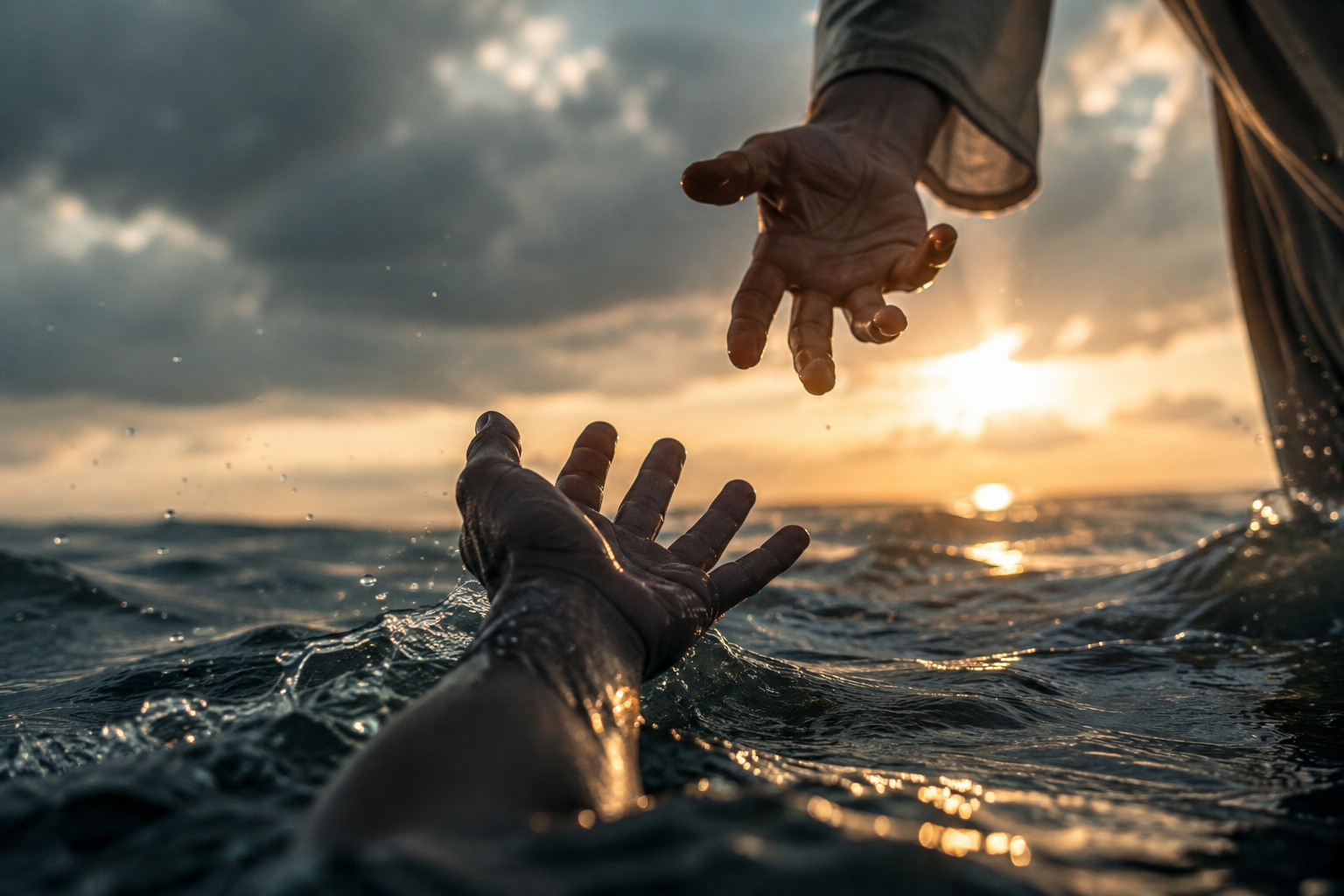
I was thinking about that when I sat down with the Gospel. Jesus sends the disciples ahead of Him in a boat while He goes away by Himself to pray. Eventually the weather turns. The wind kicks up. The boat is getting tossed. It's the middle of the night, and suddenly, the disciples see someone walking toward them on the water. Naturally, they panic. So Jesus calls out to them: “Take courage, it is I; do not be afraid.” And then Peter does something that's either incredibly brave, incredibly "Peter," or a bit of both. He asks Jesus to call him out onto the water. Jesus simply says: “Come.” So Peter gets out of the boat. And somehow, for a moment, he is doing the impossible. He's walking toward Jesus right on top of the water.
But then Matthew shares a tiny detail that feels painfully familiar to me. Peter notices how strong the wind is. And he becomes afraid. The wind was already there. The waves were already there. The danger didn't suddenly appear out of nowhere. Peter just... became consumed by it. He stopped seeing Jesus and started seeing everything that could go wrong. And he started to sink. That feels uncomfortably familiar. I do exactly the same thing, and I don't even need a boat.
I can wake up at two in the morning and stare at one problem until it fills the whole room. Maybe you know that feeling too. You start thinking about money. Or somebody you love. Or a health concern. Or your job. Or something that happened months ago that your brain has apparently decided needs another emergency meeting tonight. One worry becomes five. Five become ten. Pretty soon, your mind is three years into a future that hasn't happened, trying to survive disasters that don't even exist. Nothing around you has changed. But you feel like you're drowning anyway.
I don't think the lesson is just "Peter should've had more faith." That is easy to say when you are standing safely on shore. What gets me is what happens next. Peter does not compose himself. He does not give Jesus a beautiful prayer. He does not quote Scripture. He is sinking. So he says: “Lord, save me!” That is it. Three words. Three little words. And Matthew says Jesus immediately reaches out and catches him. Immediately. Jesus does not wait for Peter to calm down first. He doesn't make him tread water while He explains what Peter did wrong. He just catches him. I need that part of the Gospel.
See, sometimes my prayers are thoughtful and peaceful. But other times, my prayer is basically just: God, help. I don't know what to do. I'm scared. I can't stop thinking about this. Please stay with me. Apparently, that still counts. Maybe some days it's the most honest prayer we've got. Maybe some days that is the most honest prayer we have.
There is another person in this Sunday's readings who is surrounded by noise. Elijah is hiding in a cave. He's exhausted. He's been running. His world is dangerous and uncertain, and he's just waiting for God. Then comes this enormous wind, strong enough to crush rocks. But God is not in the wind. Then an earthquake. God is not in the earthquake. Then fire. God is not in the fire. And after all that? Something almost ridiculously easy to miss. A tiny whisper. A gentle sound. Silence. God was not competing with the noise. Elijah had to become quiet enough to notice Him.
That hits a bit differently when life is loud. When I'm anxious, I usually expect the solution to be loud, too. I want the giant answer. Fix the problem. Change the situation. Give me certainty. Tell me exactly what's going to happen. Make the storm stop. Instead, God often meets me with just enough grace for the next ten seconds. Breathe. I'm here. Take the next step. You don't have to solve everything tonight. That might not feel dramatic enough, but neither was the whisper.
This week's second reading reminds me that faith doesn't mean becoming emotionally bulletproof. Paul talks about having “great sorrow and constant anguish” in his heart. Constant anguish. This is Saint Paul. Apparently, being close to God doesn't mean you never have a heart that hurts. It doesn't mean being the person who walks around completely unaffected by life. We can trust God and still grieve. We can love God and still worry. We can pray and still have mornings when our chest feels tight before our feet even hit the floor.
Faith doesn't require pretending there isn't a storm. Peter really was standing on rough water. Elijah really was afraid. Paul really was hurting. And whatever you are carrying may be very real too. The question isn't whether the storm is real—it is. The question is whether it gets to be the only thing you see. Because I think that is where I lose myself. I stare at the thing I'm afraid of until it fills the whole windshield. I give one problem the entire windshield. And eventually I start steering my thoughts directly toward it. What if this happens? What if that happens? What if I can't handle it? What if it never gets better? What if... What if... What if... And all the while, somewhere underneath all that noise, God is still there. Not shouting over it. He isn't demanding that I stop feeling anxious immediately. He's just... there.
Psalm 85 says that God's salvation is near. Near. I like that word. Not waiting at the end of the perfect week. Not hiding behind the solution to everything. Just near. Here. Near. Here. Before anything gets fixed. And notice something else about the Gospel. The wind does not die down when Jesus catches Peter. Jesus catches him first. Then they get back into the boat together. Then the wind settles.
I usually get that backwards. I tell myself: "Once this situation settles down, I'll feel close to God again." "Once I have the answer, then I'll pray better." Once the money works out. Once the test comes back. Once the relationship is repaired. "Once life stops feeling so uncertain, then I'll have peace." Then I will have peace. But Jesus steps into the storm before it ends. Maybe peace is not always the absence of rough water. Maybe peace isn't always about the water being calm. Maybe it's about realizing whose hand has you while you're still standing in the middle of it.
So I am trying something very small this week. When I notice myself staring at the "truck" again, or when one worry starts taking over the whole view, I want to stop for ten seconds. Not ten minutes. Ten seconds. Look away from the screen. Drop my shoulders. Let my hands loosen. Take one slow, deep breath. And pray exactly what Peter prayed: Lord, save me. No speech. No pretending. Lord, save me. Maybe what I need saving from right then is just the panic. Maybe it's the need to control something I simply can't control. Maybe it is resentment. Maybe it's the story I'm making up about tomorrow. Maybe it's just the belief that everything depends on me.
Then I want to ask myself: What am I staring at right now? And where is Jesus in this moment? Not "where will He be when this is over?" Where is He now? At the desk with me? In the car? In the kitchen while I stare at another bill? Beside the bed at two in the morning? In the doctor's waiting room? In the ten seconds before I send the message I probably should not send? God isn't waiting for us somewhere on the other side of the storm. He's already here.
I can't promise myself the rain will stop tomorrow. I can't promise that every problem will resolve exactly how I want. Peter still had to cross the water. Elijah still had a journey ahead of him. Paul still carried sorrow. I'll probably still worry about things I wish I could surrender more easily. But maybe I do not need to see the whole road. Maybe I just need to stop staring at the fear long enough to notice the hand reaching toward me. So... if your mind has been loud lately... if you've been staring at the waves... if one problem has slowly become your entire view... you don't need an impressive prayer. Peter certainly did not have one. Three words are enough. Lord, save me. That's it. Breathe. Look ahead again. He is here.
A simple prayer to carry with you:
Jesus,
You know what's been taking up too much space in my head.
You know what I keep replaying and trying to control.
You know the things I am genuinely afraid of.
I don't want to pretend those fears aren't real.
But I also do not want them to become all I can see.
When I start staring at the storm, turn my heart back toward You.
When the noise gets loud, help me notice that You're already here.
When I begin to sink into everything that might happen tomorrow, bring me back to where You are meeting me today.
And when I don't have the words for anything fancy, hear the simple one:
Lord, save me.
Reach for me.
Steady me.
And help me remember that I don't have to wait for the storm to end before I can find You.
Amen.